

 MMM
MMM The Unseen Architect: How AI is Quietly Remodeling Our World
You probably interacted with AI before you even had your first coffee this morning. It might have been the algorithm that curated your news feed, the smart assistant that told you the weather, or the navigation app that rerouted you around a traffic jam. It’s easy to dismiss these as simple conveniences, but they are just the tip of a massive, world-altering iceberg. The real story, the one happening just beneath the surface, is about AI transforming industries from the ground up. This isn’t a futuristic prediction anymore. It’s the new operational reality, a silent revolution happening in boardrooms, on factory floors, and in hospital operating rooms. We’re talking about a fundamental shift in how businesses create value, solve problems, and connect with customers. It’s big. Really big.
Key Takeaways
- It’s Not Just Tech: AI’s influence extends far beyond Silicon Valley, revolutionizing traditional sectors like healthcare, finance, manufacturing, and retail.
- Hyper-Personalization is the New Standard: From product recommendations to medical treatments, AI enables experiences tailored to the individual at a scale never before possible.
- Efficiency and Prediction: AI automates tedious tasks, freeing up human creativity, while its predictive capabilities allow businesses to anticipate problems before they happen.
- The Human Factor is Evolving: The conversation is shifting from job replacement to job augmentation, creating new roles and demanding new skills focused on working alongside AI systems.
- Ethical Hurdles are Critical: As AI becomes more integrated, addressing challenges like data privacy, algorithmic bias, and accountability is paramount for responsible growth.
The Shockwave of Change: AI Across Key Sectors
To truly grasp the scale of this transformation, you have to look at the specifics. It’s not one single change; it’s thousands of smaller, targeted revolutions happening all at once. Let’s pull back the curtain on a few key areas where AI isn’t just a buzzword—it’s the engine of progress.

Healthcare: From Diagnosis to Drug Discovery
For decades, healthcare has been a field of immense human expertise, but also one burdened by massive datasets and the potential for human error. AI is changing that dynamic entirely. Think about medical imaging. Radiologists are incredibly skilled, but they’re also human. They get tired. An AI, however, can analyze thousands of X-rays or MRI scans with tireless precision, flagging subtle anomalies that a human eye might miss after a long shift. Companies are developing algorithms that can detect signs of diabetic retinopathy or pinpoint cancerous cells with a level of accuracy that rivals, and sometimes surpasses, human experts.
But it goes deeper. Much deeper. Personalized medicine is no longer a distant dream. By analyzing a patient’s genetic makeup, lifestyle, and medical history, AI can help doctors predict their risk for certain diseases and recommend preventative care. It’s also supercharging drug discovery. The traditional process of developing a new medication can take over a decade and cost billions. AI models can simulate how different molecular compounds might interact with diseases, dramatically speeding up the research and development phase. They can sift through millions of research papers and clinical trial results in minutes, connecting dots that would take a team of human researchers years to find. This isn’t about replacing doctors; it’s about giving them superpowers.
Finance: The New Brains Behind the Money
The world of finance moves at the speed of light, and AI is the only thing that can keep up. One of the most significant impacts is in fraud detection. When you swipe your credit card, AI systems analyze the transaction in milliseconds. They look at the location, the amount, your typical spending habits, and hundreds of other variables to determine if the transaction is legitimate. That ‘fraud alert’ text you get moments after a suspicious charge? That’s AI working for you in real-time. It’s saved consumers and banks billions.
Then there’s the world of trading. Algorithmic trading, powered by AI, now accounts for a huge portion of trades on the stock market. These systems can analyze market data, news sentiment, and economic indicators to execute trades faster than any human could ever hope to. On a more personal level, robo-advisors are democratizing financial planning. By asking a few questions about your goals and risk tolerance, these AI-driven platforms can build and manage a diversified investment portfolio for a fraction of the cost of a traditional human advisor. It’s bringing sophisticated wealth management to the masses.
Retail and E-commerce: Your Personal Shopping Assistant
If you’ve ever been amazed by how Netflix just *knows* what movie you want to watch next, you’ve experienced the power of AI in retail. Recommendation engines are the most visible application, but they are just the start. This is about creating a completely personalized shopping journey. AI analyzes your browsing history, past purchases, and even how long you look at a product to show you things you’re genuinely likely to want. It’s the digital equivalent of a helpful shopkeeper who knows your style perfectly.
Behind the scenes, the impact is even more profound. AI is optimizing every single step of the supply chain. It can predict demand for a specific product in a specific city, ensuring stores don’t run out of stock during a sales spike or get stuck with excess inventory. It can calculate the most efficient delivery routes for trucks, saving fuel and time. And when you have a question? You’re often talking to an AI-powered chatbot first. While early versions were clunky, modern chatbots can handle a huge range of customer service inquiries, freeing up human agents to tackle more complex problems. It’s a smarter, faster, and more personal way to shop.
Manufacturing: The Smart Factory is Here
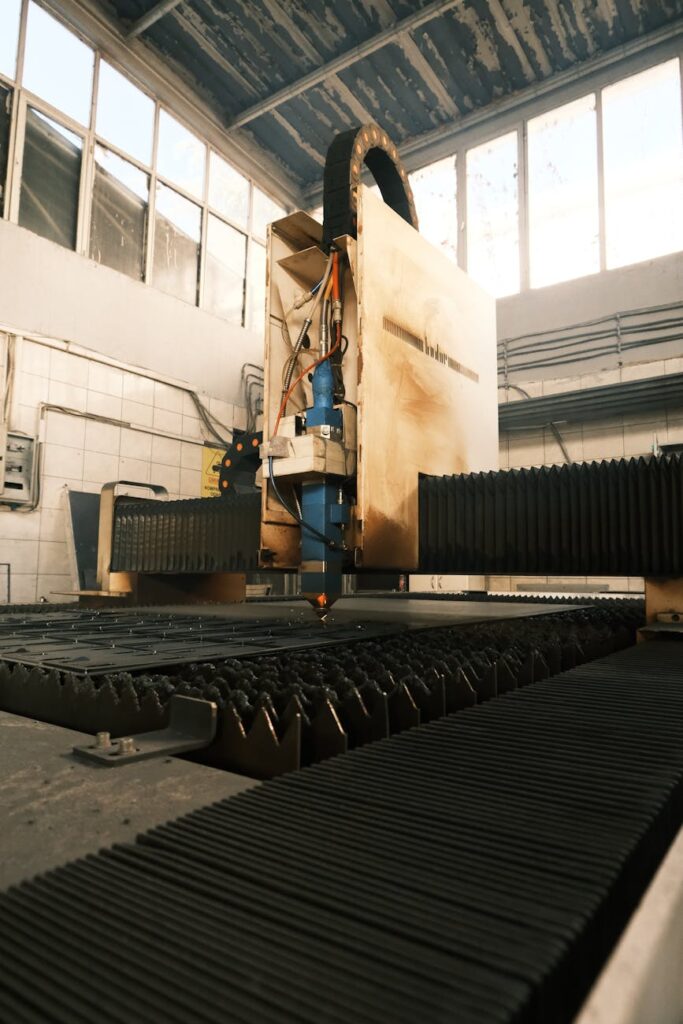
Manufacturing has always been about efficiency, and AI is cranking that dial to eleven. We’re not just talking about the simple, repetitive robots you might picture on an assembly line. We’re talking about a truly ‘smart’ factory. One of the biggest game-changers is predictive maintenance. Instead of waiting for a critical piece of machinery to break down, which can halt production for hours or days, AI uses sensors to monitor the machine’s health in real-time. It can detect tiny vibrations or temperature changes that signal an impending failure, allowing the factory to schedule maintenance *before* the breakdown happens. The cost savings are astronomical.
Quality control is another area being revolutionized. Instead of relying on human inspectors to spot defects, companies are using high-speed cameras and computer vision—a type of AI—to inspect products on the assembly line. These systems can spot microscopic flaws that are invisible to the naked eye, ensuring a higher quality product and reducing waste. It’s about building things better, faster, and more efficiently than ever before.
Beyond the Hype: Real-World Impacts of AI Transforming Industries
It’s one thing to list examples, but what’s the common thread? What are the fundamental principles that make AI so powerful across such different fields? It boils down to a few core concepts that are reshaping the very nature of business.
Hyper-Personalization: The ‘For You’ Revolution
For centuries, businesses operated on a one-to-many model. They created a product or service and sold it to the masses. The internet allowed for some segmentation, but AI enables true one-to-one personalization at scale. It’s the difference between a generic marketing email and an email that offers you a discount on the exact running shoes you were looking at last week, in your size. This extends everywhere. An AI-powered educational platform can adapt the curriculum to a student’s individual learning pace. A news app can curate a feed that prioritizes the topics you care about most. This isn’t just a better customer experience; it’s a fundamental competitive advantage.
Efficiency on Steroids: Automating the Mundane
Every job has parts that are tedious, repetitive, and time-consuming. Think data entry, scheduling meetings, processing invoices, or sifting through endless spreadsheets. AI is exceptionally good at these tasks. By automating the mundane, it doesn’t just cut costs; it liberates human potential. When a financial analyst doesn’t have to spend 20 hours a week manually pulling data, they can spend that time on higher-level strategy. When a marketing professional can use AI to generate first drafts of ad copy, they can focus on the creative vision. AI acts as a force multiplier for human talent, allowing us to focus on what we do best: creativity, critical thinking, and complex problem-solving.
Data-Driven Decisions: Gut Feel is Out
Experience and intuition will always have a place in business, but they are no longer enough. We live in a world overflowing with data, and AI provides the tools to make sense of it all. Predictive analytics can forecast future trends with startling accuracy. A retailer can predict which products will be popular next holiday season. A logistics company can anticipate shipping delays due to weather patterns. An insurance company can more accurately price risk. This moves businesses from a reactive to a proactive state. Instead of just responding to what’s happening, they can anticipate and shape what will happen next. It’s like having a crystal ball, only it’s powered by data and algorithms.
The Human Element: Navigating the AI Shift
Of course, this massive technological shift comes with its own set of challenges and very human concerns. Ignoring them would be naive. The conversation around AI must include a serious look at its impact on people and society.
The Shifting Job Market: New Roles, New Skills
The first question on everyone’s mind is usually, “Will a robot take my job?” It’s a valid concern. Some jobs, particularly those that are highly repetitive and routine, will undoubtedly be automated. But history shows that technological revolutions tend to be job transformers, not just job destroyers. The advent of the automobile eliminated the need for horse-and-buggy drivers, but it created millions of new jobs in manufacturing, road construction, and the service industry.
AI is similar. It’s creating entirely new roles that didn’t exist a decade ago—things like AI ethicists, prompt engineers, and AI trainers. The key is a shift in skills. The jobs of the future will place a premium on emotional intelligence, complex problem-solving, creativity, and the ability to work *with* AI systems. The focus must be on lifelong learning and reskilling the workforce to collaborate with these new intelligent tools, not compete against them.
Ethical Speed Bumps: Bias, Privacy, and Responsibility
AI is only as good as the data it’s trained on. If that data reflects historical human biases, the AI will learn and even amplify those biases. We’ve already seen examples of this in AI-powered hiring tools that discriminate against certain groups or facial recognition systems that are less accurate for people of color. This is a massive ethical challenge that requires careful oversight and a commitment to fairness.
Privacy is another huge concern. AI systems often require vast amounts of data to function, raising important questions about how that data is collected, stored, and used. As a society, we need to establish clear rules and regulations to protect individual privacy in the age of AI. Transparency is key; people should know when they are interacting with an AI and how their data is being used. Building trust is just as important as building the technology itself.
Conclusion
The transformation we are witnessing is not a fleeting trend. Artificial intelligence is a new form of electricity—a foundational technology that will power the next generation of innovation across every conceivable field. We’re moving from an era of programming computers to an era of training them. The impact of AI transforming industries will be more profound than the industrial revolution or the internet revolution. It will challenge our definitions of work, creativity, and even intelligence itself. The path forward will have its bumps, and the ethical questions are serious ones we must answer together. But one thing is clear: the businesses, and individuals, who learn to harness this incredible technology will be the ones who build the future.
FAQ
- Is AI going to take my job?
- It’s more likely to change your job than to eliminate it entirely. While AI will automate repetitive tasks, it’s also creating new roles and increasing the demand for human skills like critical thinking, creativity, and emotional intelligence. The future is about collaboration with AI, using it as a tool to enhance our own abilities.
- What’s the difference between AI and Machine Learning?
- Think of it this way: Artificial Intelligence (AI) is the broad concept of creating intelligent machines that can simulate human thinking and behavior. Machine Learning (ML) is a *subset* of AI. It’s the primary technique used today to achieve AI, where a system is given a large amount of data and learns to make predictions or decisions without being explicitly programmed for that task.
- How can a small business start using AI?
- You don’t need a team of data scientists to get started. Many AI tools are now available as off-the-shelf software. You can start small by using AI-powered tools for customer service (chatbots), marketing (email personalization), or accounting (automated invoice processing). The key is to identify a specific, recurring problem in your business and look for a user-friendly AI solution that can help solve it.


 AI Tools for Freelancers: Work Smarter, Not Harder in 2024
  AI and Job Displacement: Your Guide to the Future of Work
  AI’s Impact: How It’s Transforming Industries Today
  AI in Cybersecurity: The Future of Digital Defense is Here
  AI-Powered Marketing: The Ultimate Guide for Growth (2024)
  AI in Education: How It’s Shaping Future Learning
  Backtest Crypto Trading Strategies: A Complete Guide
  NFT Standards: A Cross-Chain Guide for Creators & Collectors
  Decentralized Storage: IPFS & Arweave Explained Simply
  How to Calculate Cryptocurrency Taxes: A Simple Guide
  Your Guide to Music NFTs & Top Platforms for 2024
  TradingView for Crypto: The Ultimate Trader’s Guide